About

Not a resume. A research question I couldn't put down.

Why I do this work, how a dissertation reshaped my thinking, and how over a decade in California classrooms and school leadership led here.

Jessica Rose Mathy, Ed.D. Candidate, is an educational leader and researcher whose work focuses on MTSS, adult capacity-building, social-emotional learning, relationship-centered practice, and the conditions that help schools translate evidence into sustainable action. Since 2014 her career has spanned the classroom to the district office and back again: Spanish teacher, WASC coordinator, and restorative circles facilitator at Southwest High School; Assistant Principal of Special Programs at Central Union High School District; and, from 2023 to 2025, MTSS District Coordinator at Calexico Unified School District, where she led districtwide PBIS, attendance, and SEL initiatives across eleven schools — seven elementary schools, two junior highs, a comprehensive high school, and an alternative high school.

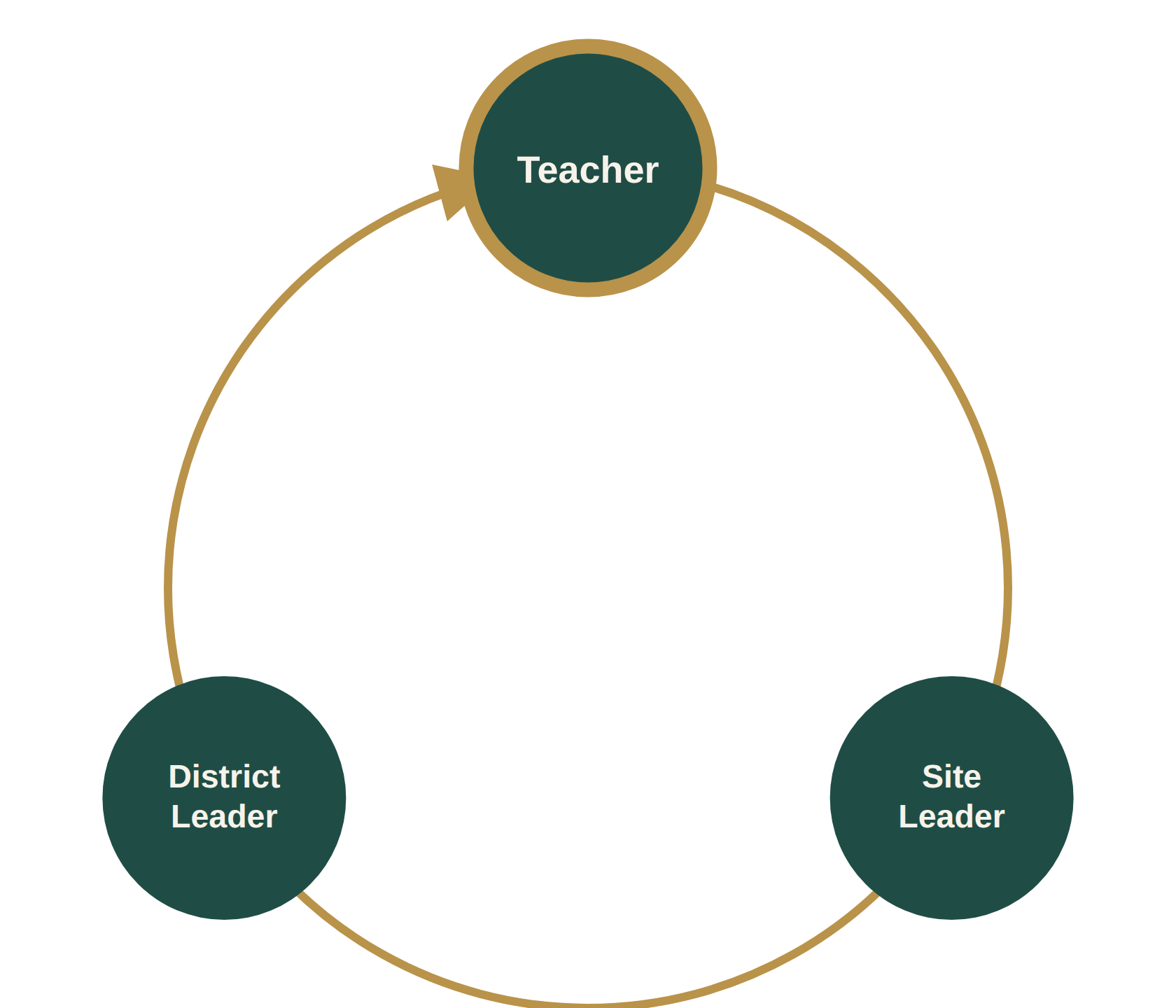
In September 2025, she made a deliberate choice to return to the classroom as a Spanish teacher at Indio High School. It was a full-circle moment — teacher, to site administrator, to district administrator, and back to teacher again — and one that mattered to her professionally as much as personally. Her last sustained stretch in a classroom had been before the pandemic; the return to in-person teaching in 2021 lasted barely six weeks before she moved into administration. Being back in a classroom full-time has sharpened her perspective in ways no district-level vantage point could: the real, everyday texture of what teachers are feeling, what students are experiencing, and what actually happens on the ground. That return to the classroom is also what gave her the space and clarity to finish her dissertation.

Her doctoral study, Professional Development (PD) & Social and Emotional Learning (SEL) Post-COVID: High School Teachers' Perspectives, completed at Grand Canyon University, examined how high school teachers experienced professional development in integrating CASEL's SEL Framework after the return to in-person learning. The study reinforced a concern that continues to guide her work: educators are frequently expected to facilitate student social-emotional growth without receiving sufficiently practical, sustained, and job-embedded opportunities to develop the adult competencies that work requires.

Jessica develops research-informed tools and public scholarship designed to make complex ideas accessible without oversimplifying the evidence. She is the developer of The SSCC Practice™, a daily practice for building connection through intentional, dignity-preserving, everyday interactions. It's informed by her doctoral research, social-emotional learning literature, relationship science, implementation science, educational leadership, and years of professional practice supporting educators — and it is currently undergoing systematic evaluation.

Portrait of Jessica Rose Mathy

Jessica Rose Mathy, Ed.D. Candidate
Educator · Researcher · Educational Leader

Connect on LinkedIn →

A cycle of four roles connected by arrows: Teacher, Site Administrator, District Administrator, and back to Teacher.
The Question

Who is developing the adults?

Finishing a dissertation is supposed to feel like an ending. It gave me a new beginning instead. After years of interviews, analysis, and revision on high school teachers' perspectives on SEL professional development after COVID-19, I expected to leave with answers. I left with one question I couldn't stop asking: who is developing the adults?

Schools ask educators to support students' self-awareness, self-management, social awareness, relationship skills, and responsible decision-making. We ask adults to recognize distress, respond to behavior, build belonging, maintain expectations, and preserve relationships — sometimes in interactions that unfold in seconds. Those are not only student competencies. They also require adult capacity.

The teachers in my study did not describe professional development as unnecessary. They described something more complicated: valuable but episodic, inconsistently prioritized, disconnected from follow-up, or too far removed from what they had to do the next morning. They wanted practical application, modeling, leadership alignment, time, reinforcement, and accountability.

Knowing why something matters is different from being able to do it under pressure.
From Practice to Practice

How professional experience shaped SSCC

Across classroom teaching, school administration, and district-level MTSS leadership, I kept returning to the same pattern: adults who deeply believed in relationships still needed something smaller to hold onto in the moment — shared language, a memorable process, repeated opportunities to practice how they wanted to show up.

The SSCC Practice™ — Steady, Scan, Connect, Close — is my attempt to translate established principles about regulation, context, relationships, accountability, and follow-through into a practical tool. It is not a proven solution, and I don't present it as one. It's a research agenda made public.

Publications & Presentations

Where else to find my work

Article · Aug 2022

Welcome to At-Promise House

Co-written with Rauna Fox for ACSA's EdCal on building a school-within-a-school credit-recovery program.

Read on EdCal →
Webinar · Sep 2023

Building Broad Buy-In for MTSS

EdWeb panelist alongside Amy Gannon (Rockford Public Schools, IL), discussing team structures for MTSS adoption.

Watch the recording →
Conference · Apr 2025

Building Districtwide PBIS Systems

Session at the 88th Annual CASCWA State Conference on architecting a collaborative, districtwide PBIS initiative.

Watch the session →

See conference listing

Core Beliefs

What I bring to every room

  • Physical safety and emotional safety are interdependent, not competing priorities.
  • Relationships do not replace accountability; they can make accountability more understandable, dignified, and effective.
  • Every adult influences school climate, whether or not safety appears in the job title.
  • Prevention is strengthened through ordinary moments of consistency, observation, communication, and follow-through.
  • Trust is built over time and cannot be demanded in a crisis.
  • Systems don't change people. People change systems.

Let's keep building safer schools — one relationship at a time.