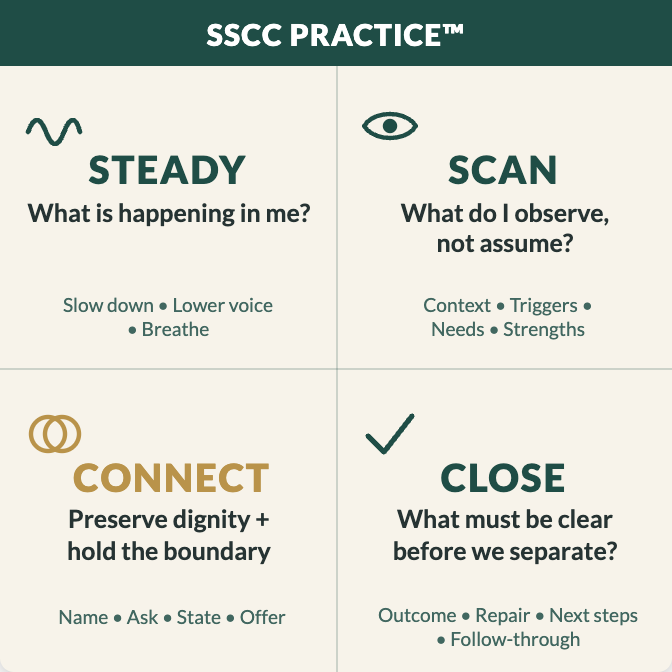
The SSCC Practice™

A Daily Practice for Better Human Connection.

Steady · Scan · Connect · Close — four simple reminders that help you pause and respond with intention instead of reacting emotionally. The SSCC Practice™ is an evidence-informed response strategy, not a curriculum or a clinical intervention — a daily practice you return to until it becomes habit.

The Problem

What can you remember when a moment turns tense?

Not a forty-page manual. Not another initiative or program to roll out. Often, the most useful support is a short sequence that helps you slow the moment down just enough to respond with intention. The SSCC Practice™ organizes four actions into a daily habit that supports good judgment during everyday interactions — with students, colleagues, family, or anyone else.

The Four Actions

Steady, Scan, Connect, Close

Teach and display the four steps in order. In real interactions, adults may move quickly, revisit a step, or act immediately for safety — the sequence is a reflective lens, not a rigid checklist.

01

Steady

Regulate yourself before you try to regulate the moment.

Slow the pace · lower the voice · ground your posture · one intentional breath

Guardrail: Safety-critical situations may require immediate action consistent with training and policy.

02

Scan

Read the room with intention. Separate observation from assumption.

Context · triggers · needs · strengths · missing information

Guardrail: Context can inform response without excusing harmful behavior.

03

Connect

Preserve dignity while maintaining the boundary.

Name · ask · state · offer

Guardrail: Never use connection language to pressure disclosure or exceed professional scope.

04

Close

End with dignity and a next step.

Outcome · repair · next step · follow-through

Guardrail: Do not promise confidentiality, resources, or outcomes you cannot guarantee.

Every interaction is an intervention.
Every intervention is an opportunity.
Every opportunity begins with connection.

What It Is

A daily practice, not a replacement

SSCC is not another initiative, program, or checklist. It's four simple reminders that help you access good judgment during brief interactions — something you practice daily until it becomes habit. In schools, it can be taught universally and applied across MTSS tiers with increasing coordination and individualization. Outside of schools, the same four reminders apply to leadership, coaching, families, and everyday relationships.

What It Is Not

Boundaries that stay in place

SSCC is not a replacement for MTSS, PBIS, restorative systems, trauma-informed approaches, SEL curricula, school policy, individualized plans, crisis response, or clinical care. Use it only within your role, training, and site procedures.

Evidence Status

What the evidence supports — and what SSCC still must demonstrate

Evidence domainWhat is reasonably supportedWhat SSCC still must demonstrate
School connectedness Associated with academic, behavioral, health, and psychological outcomes; may function as a protective factor. Whether SSCC changes student perceptions of connectedness or help-seeking.
Adult–student relationships Universal approaches can improve relationship quality, engagement, and fewer disruptive outcomes. Whether SSCC improves interaction quality across different adult roles.
Restorative & relationship-centered practice Dignity, perspective-taking, impact, accountability, and repair are established principles. Whether Connect and Close are used appropriately without weakening boundaries or safety response.
Implementation science New school practices should be tested for acceptability, feasibility, usability, fidelity, sustainability. Which supports are required for SSCC adoption and sustained implementation.
Adult regulation Conceptually relevant to de-escalation, co-regulation, and professional judgment. Whether Steady changes adult behavior or interaction trajectories in school settings.
Research status: The SSCC Practice™ is an evidence-informed practice currently undergoing systematic evaluation. Existing research supports principles that inform the practice; the specific SSCC sequence has not yet been established as an effective intervention.
Frequently Asked Questions

Common questions about SSCC

Is SSCC a Tier 1 or Tier 2 practice?

It's designed as a universal adult interaction practice usable across MTSS tiers — with increasing coordination and individualization as tier intensity increases.

Is SSCC evidence-based?

It's evidence-informed — grounded in doctoral research, social-emotional learning literature, relationship science, implementation science, and years of professional practice in schools. The complete four-part sequence has not yet been systematically tested as a unified intervention, so it isn't yet evidence-based as a validated program.

Can SSCC be used with students?

The current practice is adult-facing. A student adaptation is a plausible future direction, but it would require its own developmental review, youth advisory input, and pilot study.

Does SSCC replace crisis protocols?

No. It complements — never replaces — policy, accountability, emergency response, required reporting, and professional judgment.

Downloads

Pocket reference card

Available in two formats, both double-sided and designed for durable matte card stock. Choose whichever fits your printer or wallet better — the content is identical.

Rectangle · 3.5 × 2 in
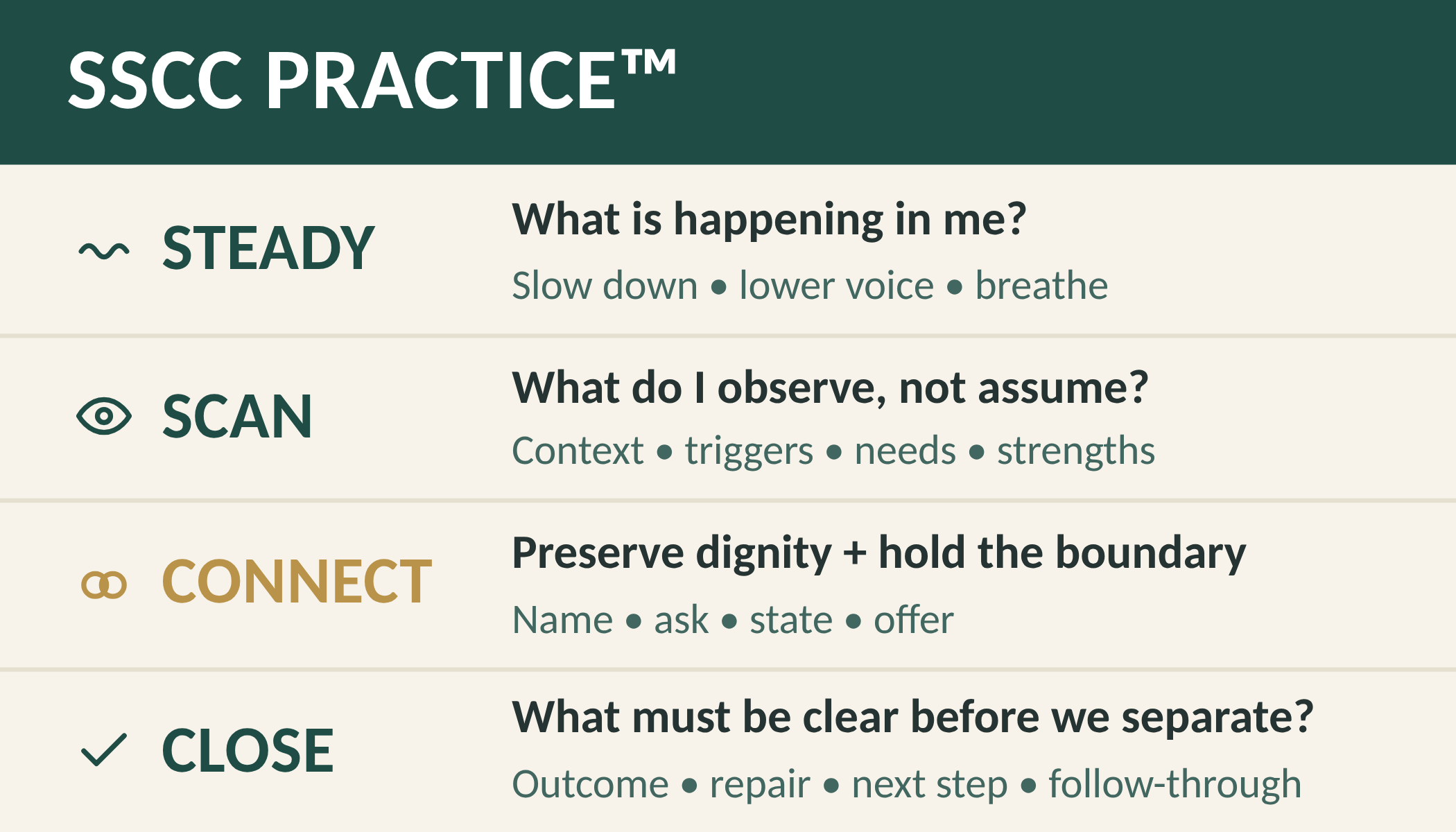
SSCC Practice rectangular pocket card showing Steady, Scan, Connect, Close.

Standard business-card size — fits in a badge holder or wallet.

Download printable PDF

Square · 3.5 × 3.5 in

SSCC Practice square pocket card showing Steady, Scan, Connect, Close in four quadrants with icons.

Larger four-quadrant layout with an icon for each step — easier to read at a glance.

Download printable PDF

Want printed copies mailed to you? Order pocket cards →

Research Agenda

The next phase is study.

Is SSCC clear, relevant, feasible, acceptable, and usable? I'm looking for university faculty, doctoral candidates, and districts willing to find out — including what's missing and what must change before stronger claims can be made.

Collaborate on research